The Challenge
A 12-person engineering team managing a 55-application portfolio had no standardized intake, planning, or delivery workflow. Work requests were tracked ad hoc, stand-up cadence was excessive, and engineers were spending more time in meetings than executing. Role clarity was absent — there was no defined RACI, no structured JIRA governance, and no single source of truth for capacity or roadmap visibility.
The Solution
Designed and implemented a full Team Operating Model — a standardized, end-to-end process workflow covering intake through post-release monitoring. Empowered Product Owners to own backlog refinement, established self-managed JIRA workflows with templated ticket standards, reduced stand-up cadence, and stood up a Monthly Business Review program with capacity planning and governance frameworks that eliminated role ambiguity and improved delivery predictability.
End-to-End Workflow
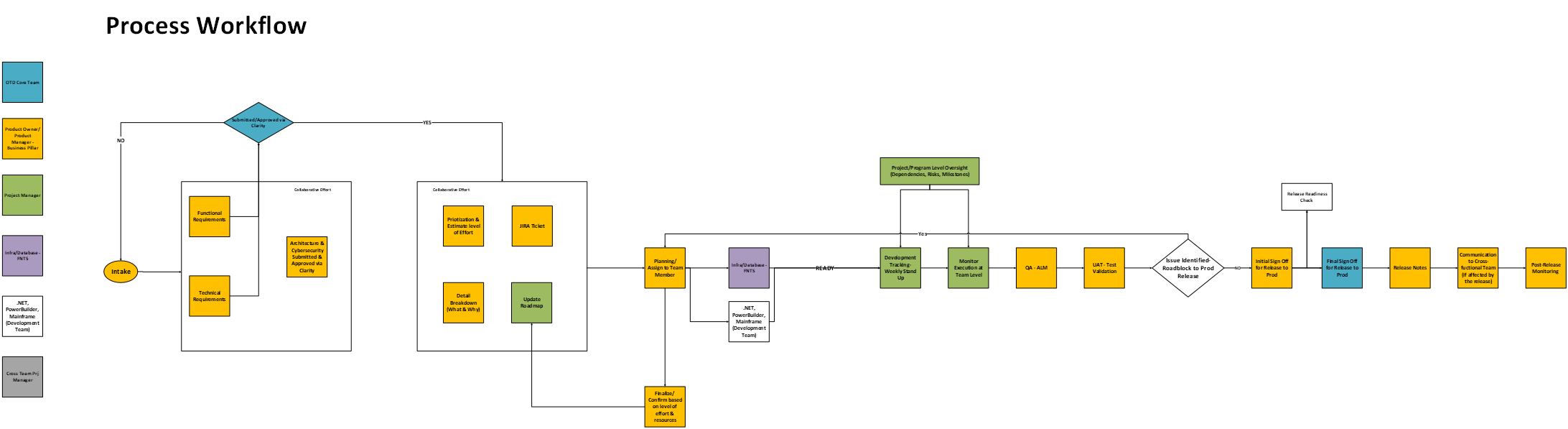
Swim-lane process diagram covering all roles and handoffs — from intake through post-release monitoring. Built in MS Visio.
Each Stage of the Process
Five sequential stages with defined owners, actions, and outcomes — eliminating ambiguity at every handoff.
- Capture all business requirements, technical requirements, and project work requests (including bugs) through the intake process.
- Outcome: Request is logged and prepared for work breakdown.
- Functional & Technical Requirements — Define the problem, context, and desired outcomes. Document business value and impact. Completed and approved via Clarity.
- Architecture & Cyber Risk Assessment — Submitted and approved via Clarity before development begins.
- Detailed Breakdown (What & Why) in JIRA — Define problem, context, desired outcomes, and document business value and impact.
- Prioritization — Requests ranked against business priorities by PO/PM and business stakeholders. Supported by the Project/Program Manager.
- JIRA Ticket Creation — Each prioritized request is logged as a JIRA ticket (Feature, Story, or Bug) by PO/PM. Epics are created by the Project/Program Manager.
- Insert to Roadmap / Kanban Board — Ticket added to the Order To Delivery project roadmap for visibility and tracking.
- Determine which team members will execute the development efforts.
- Scope out the How, Level of Effort, and assign resources.
- Define the detailed approach and provide project/program-level oversight — covering dependencies, risks, and milestones.
- Finalize and confirm plan based on level of effort and available resources.
- Project/Program Manager updates the roadmap with confirmed assignments and timelines.
- Manages detailed execution at the team level through weekly stand-ups and continuous oversight.
- Monitors execution at team level — tracking progress against plan and milestones.
- Continues oversight and escalates cross-team risks or delays (weekly cadence or as team members surface blockers).
- Validate functionality, integration, and development work using the QA environment and ALM.
- Confirm all acceptance criteria are met before release authorization.
- UAT conducted with business users to validate real-world readiness.
- Release Readiness Check → Initial Sign Off for Release to Prod → Final Sign Off for Release to Prod.
- Release Notes published and communication distributed to affected cross-technical teams.
- Post-Release Monitoring ensures stability and captures lessons learned.
Key Outcomes
Self-Directed Team
Reduced stand-up cadence and empowered Product Owners to lead backlog refinement — shifting team focus from meetings to execution.
Governance Framework
Stood up Monthly Business Reviews with standardized capacity planning, intake governance, and RACI frameworks that eliminated role ambiguity.
30% Faster Delivery
Coordinated cross-functional teams and accelerated feature delivery by 30% through structured handoffs and self-managed JIRA workflows.
100% On-Time
Maintained 100% on-time delivery across a 55-application portfolio through improved delivery predictability and proactive risk escalation.